A Day Without Video Games Retro T-Shirt: What It Offers and How to Evaluate It for Your Projects
If you have spent any time browsing print-on-demand marketplaces or DIY craft forums, you have almost certainly come across sentimental gaming slogans that tap into nostalgia. One design that keeps resurfacing is the A Day Without Video Games Retro T-Shirt graphic. The phrase is simple, but the visual execution—often pairing bold retro typefaces with gaming silhouettes—makes it more than just a line of text. For anyone considering this artwork for a t-shirt, mug, or pillow project, understanding exactly what you get, what the design is good at, and where it falls short can save time and money.
This article walks through the components that define the A Day Without Video Games Retro T-Shirt design, the file formats typically included, the practical implications of its artboard size, and how it compares with alternative gaming-themed bundles. The goal is to give you a realistic picture so you can decide whether this product fits your needs or whether you should keep looking.
What Makes the Design Distinct
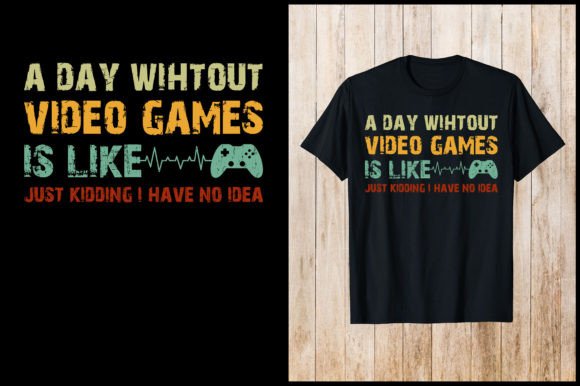
The core appeal of the A Day Without Video Games Retro T-Shirt artwork lies in its tonal balance. It is not aggressively sarcastic like some gaming slogans, nor is it overly sentimental. The phrase "a day without video games is like…" invites the viewer to fill in the blank, which makes the design feel inclusive rather than gatekeeping. The retro styling—often featuring chunky pixel-inspired type, controller silhouettes, or arcade cabinet motifs—gives it a warm, throwback sensibility that resonates with gamers who grew up in the late 1980s through early 2000s.
Unlike many gaming designs that lean heavily on photorealistic console images or complex character art, this one relies on clean shapes and strong typography. That minimalism has practical advantages. It translates well to multiple product types, from dark-heathered t-shirts to curved mug surfaces. It also tends to work across a broader age range; a 25-year-old casual gamer and a 45-year-old retro enthusiast can both find the design wearable without it feeling juvenile.
Breaking Down the Product Offering: Files, Dimensions, and Compatibility
When you purchase the A Day Without Video Games Retro T-Shirt design for print use, you are typically receiving a bundle of vector and raster files. The most common inclusion is an AI file, an EPS file, and a PNG file. Some sellers also throw in SVG cutting files, which opens up possibilities beyond direct-to-garment printing. This multi-format approach matters because each file type serves a different stage of production.
The artboard is often set to 4500 by 5400 pixels. That is an unusually vertical aspect ratio, which is worth paying attention to. At 300 DPI, that equates to a 15 by 18 inch canvas—larger than what most standard t-shirt prints require. This provides generous real estate for scaling the design up or down without quality loss, but it also means the composition may be optimized for products with a tall orientation, like wall art, long-sleeve tees with spine prints, or vertical tote bags. If you intend to use it on a wide-format mug or a standard horizontal chest print, you will likely need to adjust the layout or crop elements. That is not a flaw, but it is a design consideration you should anticipate.
The inclusion of Gaming Png, Gaming Life Eps, and Gaming Vector assets in many bundles means you are not locked into one iteration. You can separate elements—say, the controller silhouette from the text—and rearrange them for a pillow mockup or a sublimation bundle layout. This flexibility is especially valuable if you are building a cohesive collection of products under a single aesthetic.
Practical Strengths of the Retro Gaming Silhouette Approach
One underappreciated benefit of using a design built from silhouettes and clean typography is print consistency. Intricate gradients or photorealistic textures may look sharp on screen but can muddy when transferred via sublimation or screen printing onto fabrics with a looser weave. The A Day Without Video Games Retro T-Shirt graphic, by contrast, usually holds up well across printing methods. The high-contrast, flat-color shapes work reliably with DTG, screen printing, heat transfer vinyl, and even laser engraving on wood or metal accessories.
Another strength is color separation simplicity. If you are working with a screen printer that charges per color, a design with two or three solid tones is far more economical than a full-color photograph. The retro aesthetic rarely demands more than a handful of colors, which keeps production costs manageable whether you are making five shirts for a friend group or fifty for a local gaming event.
There is also a licensing angle to appreciate. Many gaming-related designs stray into copyright gray areas by using recognizable character outlines or official logos. A text-driven, silhouette-based design avoids that trap while still signaling “gamer” identity clearly. For small business owners worried about takedown notices or platform flagging, this is a very real advantage over riskier alternatives.
When the Design Fits Best and When You Might Want Something Else
The A Day Without Video Games Retro T-Shirt design is a strong candidate when your target audience values subtlety. It sparks recognition without screaming for attention. This makes it appropriate for everyday wear, casual office environments where gaming tees are acceptable, or gifts for partners and parents who enjoy gaming but do not want loud, neon character art.
It also works well in product bundles. Because the artwork arrives in formats like EPS, PNG, and SVG, you can use it across a mug, a set of coasters, a wall clock, and a pillow while keeping visual consistency. Customers browsing your online store often respond to that kind of cohesive presentation, and it can increase average order value without requiring you to source multiple unrelated designs.
However, there are situations where a different gaming graphic might serve you better. If you are targeting a younger audience that heavily identifies with specific esports titles or high-energy Twitch culture, the retro, somewhat laid-back tone may feel off-brand. In those cases, a design with faster typography, glitch effects, or vibrant RGB neon palettes might connect more directly. Similarly, if your product line revolves around photorealistic console art or highly detailed illustrations, a simplified silhouette-based design might seem too restrained. This is not a quality judgment; it is about aligning aesthetic tone with buyer expectations.
Comparing Formats: AI, EPS, PNG, and SVG in Print Workflows
If you are new to handling print-ready files, the variety can be confusing. Below is a quick rundown of how each format typically performs with the A Day Without Video Games Retro T-Shirt design and similar gaming sublimation bundles.
- AI (Adobe Illustrator): Ideal for making layout changes, resizing elements, or altering colors. If you need to adapt the artboard for a wider product—say, a laptop skin—starting from the AI file gives you the most control.
- EPS: A universal vector format that works across CorelDRAW, Affinity Designer, and other software. It is reliable when sending files to a print provider that may not use modern Adobe versions.
- PNG: Usually provided at high resolution with a transparent background. This is the easiest format for immediate upload to print-on-demand platforms. The 4500×5400 pixel size ensures it stays sharp even on larger products like all-over print hoodies.
- SVG: Essential for craft cutting machines. You can use the SVG to cut heat transfer vinyl for t-shirts, stencils for etching, or even paper shapes for cardstock projects.
Not all sellers include all four formats, so verifying what you actually get matters. A bundle that includes only a PNG file limits your ability to rework the design for non-standard product dimensions. Conversely, a vector-heavy set may overcomplicate things if you just want a quick upload. The A Day Without Video Games Retro T-Shirt package, when comprehensive, strikes a practical middle ground that serves both beginners and experienced designers.
Sublimation, Cut Files, and Expanding Beyond Apparel
The growing interest in sublimation printing has shifted what buyers look for in gaming graphics. Sublimation works by turning ink into gas that bonds with polyester fibers or polymer-coated surfaces. The result is a smooth, fade-resistant print that feels like part of the material, rather than sitting on top. For designs with bold, flat shapes—like the retro controller silhouettes in this graphic—sublimation produces exceptionally clean results on items like polyester blend tees, ceramic mugs, and throw pillows.
The Gaming Sublimation Bundle approach, where multiple related designs are packaged together, often includes mirror-ready or flip-prepared versions of the artwork. If your intended use involves a mug press or a heat press for hard substrates, check whether the EPS or AI file already has a reversed version. If not, you will need to do that manually. The high resolution of the base art makes this straightforward without visible quality degradation.
Cut files add another layer of versatility. With an SVG, you can create layered vinyl decals for car windows, gaming room wall art, or laptop lids. The silhouette nature of the design makes it cutting-friendly; intricate little details that would frustrate weeding are largely absent. This contrasts with highly detailed gaming character vectors that, while impressive, become tedious to weed at small sizes. For crafters who prioritize repeatable, sellable projects, that ease of use can be a deciding factor.
Evaluating Quality Before Committing to a Print Run
No matter how appealing the preview looks, a few practical checks can prevent disappointment. First, examine the line thicknesses at the intended print size. A design that reads perfectly at 12 inches wide may become illegible when scaled down to a 3.5-inch mug decal. With the A Day Without Video Games Retro T-Shirt graphic, the typography is typically robust, but it is still worth testing on a mockup before ordering inventory.
Second, pay attention to how the design interacts with different fabric colors. A dark silhouette on a black shirt will vanish. If the bundle includes only one colorway, you may need to add a contrasting stroke or use a lighter garment. Since the art is vector-based, making that adjustment in Illustrator or Inkscape is a minor task, but it requires that you have the right software and file access.
Third, consider how the design handles seam placement on garments. The tall artboard orientation can push elements uncomfortably close to side seams on standard t-shirts if you do not adjust the scale. A quick test print on a cheap blank can reveal whether you need to resize or reposition before committing to higher-quality stock.
Decision Factors When Choosing Between Similar Gaming Graphics
The A Day Without Video Games Retro T-Shirt design sits in a crowded field. Many sellers offer gaming slogans with comparable retro flair, but the value often lies in the details: the typeface choices, the subtlety of the gaming silhouette, and the thoughtfulness of the file package. When comparing options, ask yourself these questions:
- Does the artwork require extensive editing to work on my target products, or is it close to ready?
- Are the vector files layered, allowing me to isolate elements like the text or the controller icon?
- Is the commercial license clear about what I can and cannot use the design for?
- Does the style tone match my brand—whether that is cozy and nostalgic or edgy and competitive?
If you find that another bundle offers a more customizable layout or a color palette that better matches your existing catalog, that is not a mark against this design. It simply means your specific use case leans in a different direction. The goal is to match the strengths of the asset to the demands of the project, not to force one design to do everything.
Realistic Examples of Use Cases
To ground the evaluation, here are a few scenarios where the A Day Without Video Games Retro T-Shirt design tends to shine—and a couple where it may not.
A small gift shop at a retro arcade wants to print a line of casual apparel for customers aged 30 and up. The design’s nostalgic tone fits the venue, and the vector files let the shop owner easily produce coordinated items: a shirt, a coaster set, and a canvas tote bag. The single design creates a visually unified product line without needing to purchase multiple graphics. This is a high-fit situation.
A streamer wants to launch a merchandise collection with a identity rooted in chaotic, high-color gameplay moments. While the phrase itself is relatable, the subdued retro styling may feel at odds with the stream’s brand energy. A custom commission or a more dynamic, neon-infused gaming design might be a closer alignment.
A DIY enthusiast is making personalized gifts for a family of board game and video game lovers. They need a design that is easy to weed, forgiving to press, and gender-neutral enough to suit different tastes. The clean retro silhouette and block text check those boxes. They can also use the SVG to create matching decals for water bottles or storage bins, making the gift set feel intentionally coordinated.
Making an Informed Choice Without Overcomplicating It
At its core, the A Day Without Video Games Retro T-Shirt design is a versatile, print-friendly asset that prioritizes broad appeal over niche flash. Its value increases if you already have the tools to manipulate vector files, a clear idea of the products you want to create, and a target audience that appreciates understated gaming culture references. The inclusion of multiple file formats, the generous artboard dimensions, and the compatibility with sublimation and cutting workflows make it a practical pickup for many small-scale print producers.
No single design will be the best fit for every situation. What makes this one worth considering is the combination of technical readiness and emotional resonance it brings. It works across age groups, it prints reliably on diverse surfaces, and it avoids the legal headaches that sometimes accompany gaming-themed artwork. If those priorities align with your own, it may be exactly what your next project needs. If not, understanding its characteristics will still help you define what to look for in an alternative—and that clarity is its own kind of value.