Cartoon Military Medieval Weapons: A Vector Arsenal for Strategy Game Design
In the crowded landscape of digital art assets, finding the right toolkit can define the visual identity and development efficiency of a project. For creators working on strategy games, mobile apps, or educational software with a historical or fantastical theme, the concept of Game Medieval Weapon. Cartoon Military represents a specific and highly functional category of resources. This isn't simply a collection of realistic weapon sketches; it is a curated vector set designed with a distinct blend of historical inspiration and accessible, modern cartoon aesthetics.
Defining the Cartoon Military Medieval Style
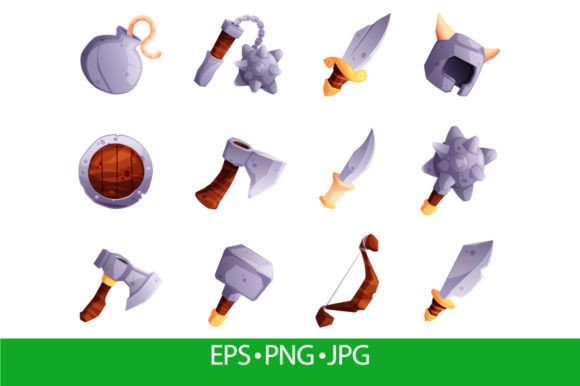
What makes this asset set distinct is its dual-purpose design philosophy. It draws from antique medieval illustration for its core shapes and historical accuracy—you will recognize the broad categories of armament like swords, maces, shields, and bows. However, it interprets these through a clean, cartoon military visual filter. This means simplified details, bold outlines, reduced textural complexity, and often a slightly exaggerated or iconic form. The result is artwork that feels historically grounded without being grim or overly detailed, making it highly versatile for interfaces, icons, and in-game graphics where clarity and quick recognition are paramount.
This approach sits between two common alternatives. On one side are hyper-realistic 3D models or detailed painterly illustrations, which offer depth but can be cumbersome for UI use and may clash with a lighter game tone. On the other are fully abstract or minimalist modern icons, which sacrifice historical flavor for pure simplicity. The Game Medieval Weapon. Cartoon Military style occupies a pragmatic middle ground, providing enough character to establish a theme while remaining functionally legible at small sizes.
Format Considerations: EPS, PNG, and JPEG
The practical value of such a vector set is greatly amplified by the inclusion of multiple standard formats. Each format serves a different phase of development or use case, and understanding their tradeoffs is key to leveraging the asset effectively.
EPS (Encapsulated PostScript) files are the cornerstone for professional design work. As vector files, they are infinitely scalable without loss of quality, allowing a single sword icon to be used on a splash screen and a tiny button. They are fully editable in applications like Adobe Illustrator, enabling designers to change colors, separate elements, or integrate parts into larger compositions. This is the format for customization and foundational design.
PNG files provided are typically rasterized versions with transparent backgrounds. Their strength lies in immediate usability. Developers can drop them directly into game engines, presentation software, or web pages without needing vector editing skills. The transparency is crucial for overlaying icons on varied backgrounds. However, they are fixed-resolution; scaling up will cause pixelation, so they are best used at their intended size.
JPEG formats are less common for such icons due to their lack of transparency, but they may be included for specific scenarios like quick placeholder art, backgrounds where a white rectangle is acceptable, or for use in internal documentation. Their smaller file size can be an advantage for rapid prototyping.
The decision factor here often depends on the user's role. A graphic designer or art lead will prioritize the EPS files for control and scalability. A solo developer or content creator with limited design software might rely primarily on the pre-made PNGs for speed. A comprehensive set offering all three, like the one described, accommodates both workflows and team collaboration.
Best-Fit Applications and Use Cases
This style of medieval weapon asset is particularly well-suited for certain project genres and design goals. Its strengths shine in:
- Strategy and Tactical Games: Especially those with a lighter, more approachable tone. Icons for unit types, resource costs, attack values, or special abilities require clear, thematic symbols. A cartoon bomb or arrow can convey "siege weapon" or "archer unit" effectively without overwhelming the player with detail.
- Educational and Children’s Software: Apps teaching history or medieval life benefit from engaging, non-threatening imagery. The cartoon filter makes historical weaponry more accessible and less violent in appearance.
- Mobile Game Interfaces: Where screen space is limited and icon clarity is critical. The bold outlines and simplified forms of cartoon military designs remain readable on small displays.
- Board Game Digital Assets or Rulebook Graphics: Providing a consistent visual theme for physical game companion apps or printed materials.
A key limitation, however, is tonal mismatch. This asset set would be a poor fit for a dark, gritty, historically brutal simulation aiming for realism. If your project's aesthetic demands rust, blood, and weathered textures to convey a sense of harsh medieval life, these clean, cartoon vectors would undermine that goal. Similarly, for a purely abstract puzzle game with no narrative theme, these assets might introduce unnecessary stylistic noise.
Comparing to Other Asset Categories
When evaluating resources, it's useful to consider where this category differs from other common options. A realistic medieval weapon pack, often in 3D, offers immersion and detail for first-person games or high-fidelity renders but requires more performance resources and design skill to implement. A pure pixel art set offers a different kind of nostalgia and is excellent for retro-style games, but lacks the scalability and editing ease of vectors. A generic fantasy icon pack might include magical elements alongside weapons, which could be useful but may dilute the specific military/historical focus.
The Game Medieval Weapon. Cartoon Military set is defined by its intentional narrowing: it is historical (medieval), non-magical (military), and stylized (cartoon). This focus makes it a powerful choice when your project's needs align precisely with that intersection. It saves time from filtering out irrelevant assets from broader packs.
Decision Factors for Creators
Choosing whether this vector arsenal is the right resource involves a few practical considerations. First, assess the visual tone of your project. Does "cartoon military" align with your art direction? Creating mood boards or style guides early can answer this. Second, evaluate your team's capabilities. Do you have the software and skill to utilize and potentially modify EPS vector files? If not, does the PNG set provide all the icons you need at the resolutions you require?
Third, consider scope and scalability. Are you creating a single game or a suite of related products? Vector assets offer greater long-term value as they can be adapted for sequels, marketing materials, or merchandise without degradation. Fourth, think about complementary assets. Will you need matching character art, environments, or UI elements in the same cartoon military style? Using this weapon set may commit you to a stylistic path that requires finding or creating compatible artwork for other game elements.
In practice, a developer building a lighthearted castle-defense mobile game might find this set perfect. The cartoon style fits a casual audience, the PNG icons integrate easily into Unity or a similar engine, and the historical weaponry provides clear visual cues for different tower upgrades. Conversely, a team developing a detailed historical wargame simulation would likely need to look elsewhere, perhaps towards 3D asset libraries or commissioned realistic artwork, to meet their audience's expectations for authenticity.
When It's the Right Choice, and When to Look Elsewhere
Ultimately, Game Medieval Weapon. Cartoon Military assets are a strong, pragmatic choice for projects that require a specific blend of thematic clarity and stylistic accessibility. They reduce the design burden of creating a coherent icon set from scratch and offer flexibility through multi-format delivery. Their value is highest when the project's vision already leans towards a stylized, non-realistic interpretation of medieval conflict.
You may need another option if your project demands either extreme realism or a completely different artistic style (like sci-fi, modern, or pure abstraction). Also, if your needs extend beyond weapons to include full character models, complex animations, or environmental props, this focused set will be only a partial solution, requiring you to source additional, stylistically matching assets. In such cases, a broader, more comprehensive game art pack or a custom art commission might be a more suitable starting point, despite likely higher cost or complexity.
By understanding the distinct niche these assets fill—the intersection of historical reference, military focus, and cartoon simplification—creators can make a more informed decision. Evaluating them against your project's specific tone, team workflow, and long-term needs will reveal whether this vector arsenal is a handy toolkit or a stylistic mismatch. In the right context, it provides a foundation of visual elements that are both immediately usable and deeply adaptable, allowing you to focus more on gameplay and mechanics rather than the intricate details of every sword and shield.