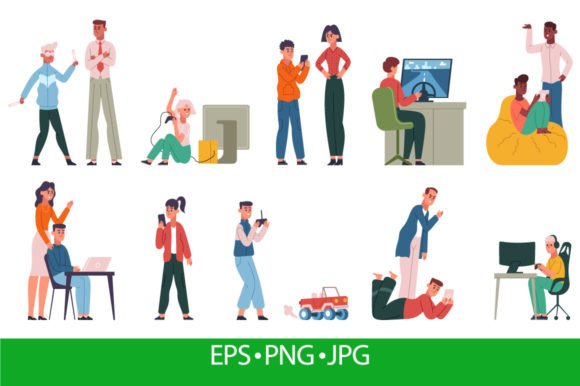
The Educational Game Abstract Concept Vector: Beyond Just a File Download
When you search for an educational game abstract concept vector, you’re likely looking for more than just a graphic. You’re seeking a visual shorthand for an entire philosophy of modern learning—the intersection of play, engagement, and education. This versatile illustration, often depicting a gamified learning system, magnetic constructors, and playing kids, is a powerful asset for creators, educators, and marketers aiming to communicate contemporary pedagogical ideas visually. However, treating it merely as a PNG or JPG file to be dropped into a project is the first and most common oversight. The true value lies in understanding its application as a fully editable, scalable concept vector.
The Core Misunderstanding: Static Image vs. Dynamic Asset
Many beginners and even seasoned professionals fall into the trap of evaluating these vectors based on the preview image alone. They focus on the immediate color scheme or the specific arrangement of playing kids and game elements in the flat vector illustration. This leads to a critical mistake: choosing a file based on a locked composition, rather than its potential as a customizable foundation.
For instance, a blogger might download a JPG file because the blue and green colors in the preview perfectly match their website palette. Weeks later, when needing to adapt the graphic for a print brochure with a different color scheme, they’re stuck. The JPG cannot be easily altered, forcing them to either settle for mismatched visuals or purchase a new asset. This affects brand consistency, project efficiency, and ultimately, cost. The overlooked detail here is the file format list: SVG, AI, EPS. These are the keys to flexibility.
Practical Advice: Prioritize Edibility Over Pre-Made Perfection
Before downloading or purchasing any educational game abstract concept vector, your first check should be the included file types. A package offering only PNG and JPG is a finished product; one offering SVG and Adobe Illustrator EPS files is a toolkit. Always opt for the toolkit. This allows you to scale the graphic infinitely for a large banner or a tiny app icon without quality loss. More importantly, you can easily change colors, separate elements (like isolating the magnetic constructor icon), or recompose the scene to fit your specific narrative—say, emphasizing the gaming education platform over the play and learn aspect.
A better approach: Search for vectors explicitly labeled “Fully Editable.” Download the SVG file and open it in a free tool like Inkscape or your preferred Adobe Illustrator version. Immediately test its edibility by changing one element’s color and moving an object. This quick test saves future frustration and unlocks the asset’s full potential for all your applications.
The Application Blunder: Misaligning Visual with Audience
Another frequent error is applying the vector illustration without considering the semantic message it conveys. The abstract concept vector is rich with symbolism. The flat design style conveys clarity and modernity; the gaming elements signal interactivity; the children figures imply a user-focused, joyful experience. Using this graphic to represent a dry, administrative e-learning management system creates a visual dissonance that confuses your audience and undermines communication.
An entrepreneur, for example, might use a vibrant, child-centric gamified learning system vector on their homepage for a serious professional certification platform aimed at adults. While gamification is applicable, the specific imagery feels misplaced, potentially reducing the perceived credibility (E-E-A-T) of their service. The mistake is assuming all “educational game” vectors are generic. They are not.
Correcting the Approach: Deconstruct the Concept
Before using the vector, deconstruct its components. Ask: Does the “play and learn” imagery suit my brand’s tone? Are the illustrated kids appropriate for my target demographic of adult professionals? Can I modify the vector to better align? The beauty of a fully editable file is that you can adapt it. Perhaps you remove the children figures and emphasize the platform interface or game mechanic icons within the scene. Your check here is conceptual alignment. Use the vector not as a literal depiction, but as a conceptual starting point that you can tailor.
This solution-focused mindset ensures the asset enhances your project’s message. For a marketing email about a new gaming education platform, the unmodified vector might work perfectly. For a technical whitepaper on the backend architecture of that platform, you might extract just the abstract, geometric game elements from the SVG file to use as section icons.
The Overlooked Scalability Factor: From Web to Print
A key feature touted is “Easy Scalable,” but many users overlook the practical requirements this entails. Scalability isn’t just about resizing without pixelation; it’s about the asset performing across different media. Using an RGB color vector (ideal for screens) directly for a CMYK print job can lead to muted and disappointing color results. This is a technical detail often missed by hobbyists and small business owners rushing to finish a project.
The impact is a final presentation—like a conference brochure or business card—that looks unprofessional and color-flat, reducing the visual impact of your carefully chosen concept. The vector file itself is capable, but its application was flawed.
What to Check Before Final Use
Always confirm your output medium. If your final use is print, you must convert the RGB colors in your editable Adobe Illustrator file to CMYK and check the results. This simple step, often forgotten in the excitement of having a “resizable” graphic, guarantees quality across all applications. Furthermore, test scalability by printing a sample at the largest intended size. The vector’s mathematical paths should ensure crisp lines, but verifying this avoids last-minute surprises.
Beyond the Download: Integrating the Concept into Your Work
The final, holistic mistake is viewing the educational game abstract concept vector as an isolated decorative element. Its greatest power is in reinforcing your content’s theme across multiple touchpoints. A single purchase of a comprehensive vector pack (with AI, EPS, SVG files) should fuel your entire campaign’s visual identity.
A marketer might use the full scene on a landing page, extract the “play and learn” icon for social media posts, use the isolated gaming elements for infographic bullets, and employ the color palette from the vector for their overall design scheme. This creates a cohesive, recognizable, and professional look that strengthens user satisfaction and brand recall. The oversight is using the asset once and forgetting it, rather than leveraging its editable nature for systematic design.
Your practical strategy should be to plan multi-use from the start. When you evaluate a vector illustration, think: “Can this serve as my primary visual motif?” Look for packages with multiple file formats and a coherent design style that you can break apart. This approach transforms a simple graphic download into a cost-effective, versatile design resource that supports clear communication and high-quality presentation for all your projects, from blog posts to client presentations.
In essence, an educational game abstract concept vector is more than a picture of a gaming education platform. It is a customizable, scalable, and semantic tool for visually articulating the ideas of engagement, innovation, and modern learning. By avoiding the common pitfalls of format choice, conceptual misalignment, and underutilization, you unlock its true value, ensuring your visual communications are as effective and dynamic as the educational concepts they represent.